Meal-Prepping Dog Food for a French Bulldog: What to Know First
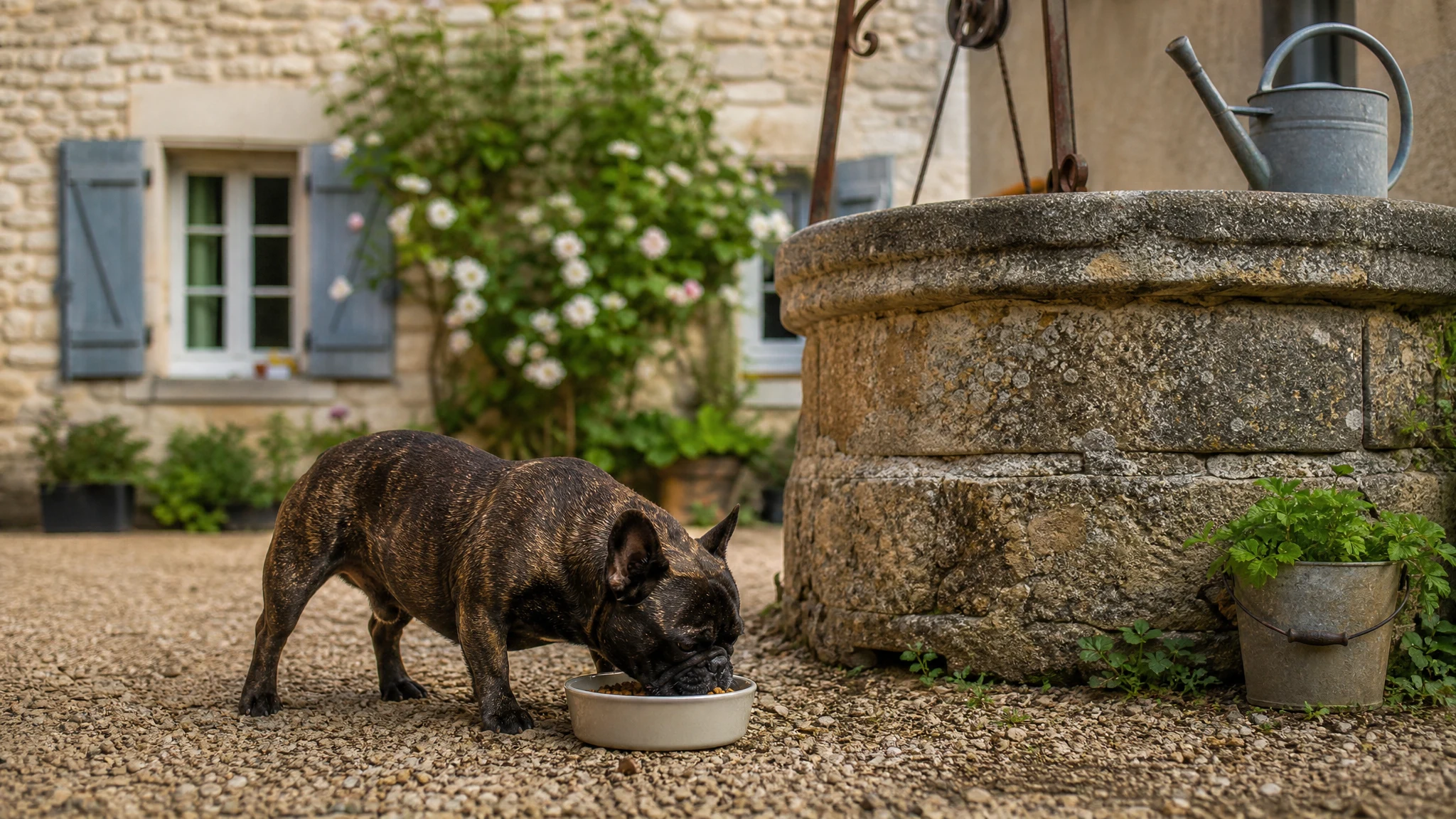
General nutrition information compiled from product labels and published sources, not veterinary advice. Your veterinarian is the right person to choose a diet for your dog, especially one with a health condition.
Meal prep for a dog mostly means measuring, portioning and storing food ahead of time. Done well, it makes busy mornings easier and helps you feed the same amount every day. That matters for a French Bulldog, because the AKC breed page says Frenchies are prone to obesity and owners should watch calorie intake and weight.
This guide covers dog feeding preparation for a French Bulldog using commercial foods. It does not offer home-cooked recipes. A homemade diet is something to plan with your veterinarian.
A note on method: the food details below come from the labels and product pages of the brands named. We compared label data. We did not run feeding trials or taste tests.
Why portioning matters for this breed
The AKC lists adult French Bulldogs at under 28 pounds and 11 to 13 inches tall. That is a small body, so a few extra kibbles a day add up faster than owners expect.
Weight also ties into breathing. Cornell University's Riney Canine Health Center lists maintaining a healthy weight among the management steps for brachycephalic obstructive airway syndrome (BOAS). A food does not treat BOAS. But steady, measured meals are one way to keep weight in check, and your veterinarian can tell you what a healthy weight is for your dog.
Materials you will need
- A dry measuring cup, or better, a kitchen scale that reads in grams
- Airtight food containers for dry food, kept away from heat and damp
- Small lidded containers or freezer-safe containers for wet or fresh food portions
- A marker and labels or tape for dates and amounts
- A notebook or phone note for your dog's weight and daily amounts
- The food's original bag or can, so you can check the feeding table and the date
Step-by-step: preparing a week of meals
Step 1: Confirm life stage and food type
Start with the label's nutritional adequacy statement. It tells you whether the food is formulated for growth, maintenance or all life stages. Royal Canin, for example, feeds its French Bulldog puppy formula from 8 weeks to 12 months and its adult formula from 12 months. That is manufacturer guidance, not a rule for every dog, so ask your veterinarian when to switch.
Puppy foods can use different wording. Royal Canin's French Bulldog Puppy formula says it meets AAFCO growth levels "including growth of large size dogs (70 lb. or more as an adult)." That wording describes how the food is formulated. It is not a size recommendation for your dog. Frenchies are listed by the AKC at under 28 pounds.
Step 2: Find the starting amount on the label
Feeding tables are starting points, not prescriptions. Here are examples straight from the brands' own pages:
- Royal Canin French Bulldog Adult dry food, for an 18 lb (8 kg) dog: 1 1/4 cups (111 g) a day at low activity, 1 1/2 cups (128 g) at medium and 1 3/4 cups (146 g) at high. The food lists 331 kcal ME per cup.
- Royal Canin French Bulldog Puppy dry food, at 2 months with a target adult weight of 18 lb: 1 1/4 cups (122 g) a day. The food lists 373 kcal ME per cup.
- Hill's Science Diet Adult Small & Mini Chicken & Brown Rice, for a 20 lb dog: 1 2/3 cups (160 g) a day, and 2 cups (190 g) for 25 lb. The food lists 357 kcal per cup.
Notice the gap between brands. A cup of puppy food holds more calories than a cup of adult food, so you cannot swap one food for another cup for cup. Hill's Small & Mini formulas are labeled for dogs up to 25 pounds when full grown. A Frenchie at the top of the AKC range, 26 to 28 pounds, sits just above that label. Check with Hill's or your veterinarian if your dog is in that range.
For a full breakdown by age, see our French Bulldog feeding chart by age.
Step 3: Weigh your dog and adjust for activity
Weigh your dog on the same scale each time. Pick the row of the feeding table that matches the current weight, not the weight you hope for. Then choose the activity level honestly. A dog who takes short, slow walks in warm weather is probably in the low-activity row.
If your dog has a health condition, is overweight or is on a veterinary diet, confirm every amount with your veterinarian before you prep. Prescription diets are only something a veterinarian prescribes.
Step 4: Decide how many meals a day
The labels give a daily total. They do not set a meal schedule for a French Bulldog, so ask your veterinarian how many meals suit your dog's age and health. Once you have an answer, divide the daily amount by the number of meals. Keep a set time for each meal so your dog can settle into a routine.
Step 5: Portion dry food
- Set a container on the scale and zero it.
- Weigh one day's food, or one meal, in grams. Scoops vary a lot, and a heaping cup can add many extra calories.
- Pour each portion into a small container or reusable bag, label it and stack the week's portions.
- Keep the main supply in its original bag, placed inside an airtight container. The bag carries the lot number and best-by date.
Step 6: Portion wet and fresh food safely
Canned food is simple. Royal Canin's adult loaf in sauce lists 70 kcal ME per can, so you can count cans toward the day's total. Hill's feeding tables for its canned foods count in cans by weight. Once opened, cover and refrigerate leftovers, and check the label for how long they keep.
Fresh foods have stricter handling rules. JustFoodForDogs says to store its fresh frozen Chicken & Rice Recipe in the freezer and thaw it in the refrigerator. Hill's says its refrigerated Chicken & Brown Rice fresh roll must stay below 40°F (4°C) and must not be frozen. Those two instructions point in opposite directions, so read the specific package. Do not assume that all fresh food can be frozen in portions.
Step 7: Label, store and log
Write the date and amount on each container. Record your dog's weight every week or two. If the weight drifts up, adjust the portion slightly and tell your veterinarian. Do not make large cuts on your own.
Mixing foods and changing foods
If you combine dry and wet food, count both toward the daily calories. Royal Canin describes its loaf as a standalone meal or as a mix with the dry formula. When mixing, reduce the dry portion rather than simply adding the wet food on top.
When you change foods, do it over several days and watch for stomach upset. Ask your veterinarian for a transition plan, especially for a puppy or a dog with a sensitive stomach.
Tips for easier prep
- Weigh in grams. It is more consistent than scooping.
- Prep only as much fresh food as the package says it will keep.
- Count treats and chews toward the day's calories. Taking them out of the meal portion keeps the total steady.
- Look at kibble shape. Royal Canin designs its French Bulldog kibble to be easy to pick up with a short muzzle and underbite. Hill's lists small-dog kibble for its Small & Mini formulas. Either way, watch how your own dog eats.
- Wash bowls and containers daily.
Common mistakes to avoid
- Feeding from the bag by eye. Small errors repeat every day.
- Using one cup measure for every food. Calories per cup differ by brand and life stage.
- Treating the feeding table as fixed. It is a starting point. Body condition and your veterinarian's advice come first.
- Switching to a puppy or adult food by date alone. The 12-month mark is a manufacturer guide, not a deadline.
- Adding supplements to portions. Do not add any without your veterinarian's direction. We do not give amounts for supplements.
- Freezing food that says not to freeze. Follow each package.
- Choosing a food because of one ingredient trend. See the next section.
A note on grain-free and DCM headlines
You may see worry about diet and dilated cardiomyopathy (DCM). The U.S. FDA says its investigation has not established a causal link. FDA reports that adverse event report counts alone do not establish a causal relationship with the products reported. It received 1,382 DCM reports from January 1, 2014 to November 1, 2022, involving both grain-free and grain-containing diets. FDA also says it has not requested recalls and has no definitive information that the diets are inherently unsafe. If you have a concern about your dog's heart or diet, ask your veterinarian.
What to expect
Prepped portions may make daily feeding quicker and more consistent. Measuring may also help you notice weight changes sooner. Results vary by dog, and no feeding routine can promise a particular weight or health outcome. A food does not prevent or treat hip dysplasia, skin problems, BOAS or any other condition. If your Frenchie has itching, digestive upset, breathing trouble or unexplained weight change, see your veterinarian before changing the diet.
Use the label amount as a starting point, track weight, and have your veterinarian review the plan at checkups. The AKC lists a typical lifespan of 10 to 12 years for the breed, so a steady habit now has plenty of time to pay off.
Sources
- American Kennel Club: French Bulldog breed page
- Cornell University College of Veterinary Medicine: Brachycephalic Obstructive Airway Syndrome (BOAS)
- U.S. FDA: Investigation into Potential Link between Certain Diets and Canine Dilated Cardiomyopathy
- U.S. FDA: Questions & Answers on Non-Hereditary DCM in Dogs
- Royal Canin: French Bulldog Adult Dry Dog Food
- Royal Canin: French Bulldog Puppy Dry Dog Food
- Hill's Science Diet: Adult Small & Mini Chicken & Brown Rice Recipe
- Hill's Science Diet: Adult Single Protein Chicken & Brown Rice Fresh Dog Food Roll
- JustFoodForDogs: Chicken & Rice Recipe