Dog Feeding Preparation Mistakes That Can Affect a French Bulldog's Digestion
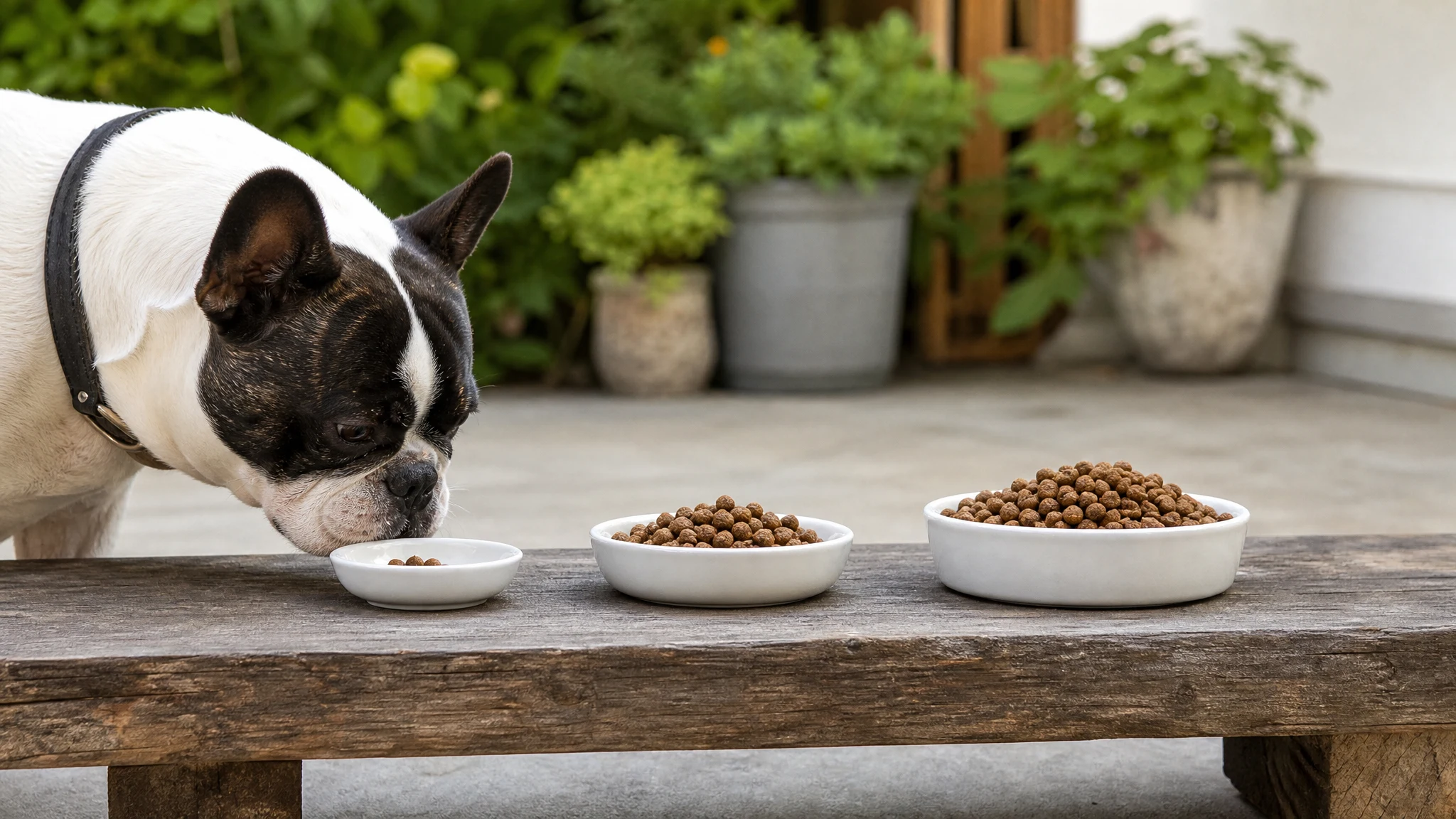
General nutrition information compiled from product labels and published sources, not veterinary advice. Your veterinarian is the right person to choose a diet for your dog, especially one with a health condition.
Most feeding trouble starts before the bowl hits the floor. Scooping by eye, switching foods overnight and storing fresh food badly are small habits, and they are easy to fix.
This guide walks through dog feeding preparation for a French Bulldog in plain steps. It points out where owners most often slip. It does not diagnose anything. If your dog has loose stools, vomiting or any health condition, a veterinarian decides what to do.
Why preparation matters for this breed
The AKC breed page lists the French Bulldog at under 28 pounds and 11-13 inches tall. It also says Frenchies are prone to obesity, so calorie intake and weight need watching. Cornell University College of Veterinary Medicine's Riney Canine Health Center lists maintaining a healthy weight among the conservative measures for brachycephalic obstructive airway syndrome (BOAS), a condition common in flat-faced breeds.
None of that says a particular food causes or prevents a problem. It does mean a small dog with little room for extra calories gains from careful, repeatable meal prep.
Materials you need
- The food bag or can, with the full label and the feeding table
- A standard dry measuring cup, or better, a kitchen scale that reads in grams
- A clean, shallow bowl that suits a short muzzle
- An airtight container for dry food, or the original bag placed inside it
- A notebook or phone note to log meals, treats and stool quality
- Your dog's current weight, from a home scale or your veterinarian's office
Step 1: Read the label before you scoop
Start with the adequacy statement. It says whether the food is complete and balanced for maintenance, growth or all life stages. Brands word it differently. Royal Canin's French Bulldog Adult formula states it meets the AAFCO Dog Food Nutrient Profiles for maintenance. Its puppy formula states it meets them for growth.
Common mistake: feeding a puppy food to an adult, or the reverse, because the bag was already open. Royal Canin's own guidance moves French Bulldogs from its puppy formula to its adult formula at 12 months. That is manufacturer guidance, not a rule from a vet school or a breed club, so ask your veterinarian when your dog should switch.
You may also see the phrase "including growth of large size dogs (70 lb. or more as an adult)" on a growth or all-life-stages food. Under the Kentucky Agricultural Experiment Station's 12 KAR 3:039, which follows the AAFCO model wording, a food must carry either that phrase or "except for growth of large size dogs". The Royal Canin French Bulldog Puppy label carries the first one. That describes how the food was formulated. It is not a size recommendation, and a Frenchie stays well under 70 pounds.
Step 2: Find a starting amount from the label
Every feeding table is a starting point. Match your dog's weight and activity level to the row, then adjust with your veterinarian based on body condition.
A few label examples show how much the guides vary:
| Food | Label example |
|---|---|
| Royal Canin French Bulldog Adult (dry), 331 kcal ME per cup | 18 lb dog per day: 1 1/4 cups at low activity, 1 1/2 cups at medium, 1 3/4 cups at high |
| Royal Canin French Bulldog Puppy (dry), 373 kcal ME per cup | At 2 months, target adult weight 18 lb: 1 1/4 cups (122 g) per day |
| Hill's Science Diet Adult Small & Mini (dry), 357 kcal per cup | 20 lb dog per day: 1 2/3 cups (160 g); 25 lb dog: 2 cups (190 g) |
We compared label data only. We did not run feeding trials or taste tests. Note that Hill's Small & Mini formulas are labeled for dogs up to 25 pounds at full size, so a 26-28 pound Frenchie sits just above that range. Check with the brand or your veterinarian before relying on that table.
For a broader look at portions by age, see our guide on how much to feed a French Bulldog by age.
Common mistake: using the number on the bag for a different weight or life stage. A cup of one food holds a different number of calories than a cup of another, so never carry a cup measure from one food to the next.
Step 3: Measure every meal the same way
- Place the empty bowl on the scale and zero it, or level the dry measuring cup with a flat edge.
- Weigh the food in grams when the label gives grams. Label cup sizes can be loosely filled, and scoops from the bag are rarely consistent.
- Divide the daily amount by the number of meals you feed. Many owners of small dogs split the day into at least two meals, but your veterinarian can advise on the schedule that suits your dog.
- Count treats and toppers as part of the day's food, not extra.
Common mistake: topping up the bowl "just a little" because the dog begs. Those small additions add up fast in a dog under 28 pounds, and weight gain is the breed concern the AKC highlights.
Step 4: Switch foods gradually
Changing foods in one meal is one of the most common causes of an upset stomach in dogs generally. Instead, blend the new food into the old in growing proportions. Many brands print their own transition advice on the bag or product page. Follow that, and ask your veterinarian if your dog has a sensitive stomach.
During the switch, recalculate the amount for the new food. Calories per cup differ, as the table above shows. Watch stool quality and appetite, and write it down.
Common mistake: changing foods and adding a new treat in the same week. If something goes wrong, you cannot tell which change did it.
Step 5: Handle fresh, wet and dry food correctly
Storage rules differ by format, so read each one:
- Dry food: keep it sealed and dry, and use the brand's guidance on how long an opened bag stays fresh.
- Refrigerated roll: Hill's Science Diet's fresh roll says to keep it refrigerated at all times below 40°F (4°C) and not to freeze it.
- Fresh frozen: JustFoodForDogs says to store its recipes in the freezer and thaw them in the refrigerator.
- Canned or loaf: check the can for how to store leftovers. Royal Canin describes its French Bulldog loaf in sauce as a standalone meal or something to mix with its dry formula.
Common mistake: leaving thawed or opened wet food out at room temperature, or freezing a product the label says not to freeze.
Step 6: Serve in a way that suits a short muzzle
Royal Canin says its French Bulldog kibble has a curved shape designed for the breed's short muzzle and underbite, so it is easy to pick up and chew. Other brands do not make that claim, so you may notice how your own dog handles a given kibble. A shallow bowl and a calm, unhurried feeding spot make it easier to see how your dog eats.
If your dog gulps food, tell your veterinarian. Do not change the food type on a guess.
Step 7: Keep a simple log
For two to three weeks after any change, note the date, the food, the amount, the treats and the stool quality. Bring the log to your next vet visit. It gives your veterinarian real information instead of guesses.
More mistakes to avoid
- Choosing by marketing words. Terms like "premium" or "natural" are not nutrition data. Look at the adequacy statement, the ingredient list and the calories.
- Assuming grain-free is safer. The U.S. FDA's DCM investigation says reports involve both grain-free and grain-containing diets. It also says report counts alone do not establish a causal relationship. Its Q&A lists 1,382 DCM reports submitted between January 1, 2014 and November 1, 2022. FDA has not requested recalls. Ask your veterinarian rather than reading a single ingredient as good or bad.
- Expecting food to fix a skin or joint issue. The AKC lists skin allergies as a concern for the breed but does not say they are food-related. The parent club's health recommendations list hip dysplasia screening. Neither source ties a diet to preventing or treating these. Only a veterinarian can say whether a diet change or a prescription diet fits your dog.
- Adding supplements on your own. Ask your veterinarian first. We do not give supplement amounts.
What to expect
With consistent measuring, a gradual switch and sound storage, many owners find meals easier to track and weight easier to manage. Stools may look more regular, though results vary by dog and no food or routine can promise a particular outcome. Persistent loose stools, vomiting, weight change or a drop in appetite are reasons to call your veterinarian.
If your dog has a health condition, including a breathing issue such as BOAS, confirm amounts and food choices with your veterinarian before changing anything. Weight goals in particular should be set by them.
Quick checklist
- Read the adequacy statement and match it to your dog's life stage.
- Start from the label's feeding table for your dog's weight and activity.
- Weigh meals in grams where possible.
- Count treats in the daily total.
- Switch foods gradually and change one thing at a time.
- Store each food format as its label says.
- Log meals and stools, then share the log with your veterinarian.
Product details above come from each brand's own pages. For current ingredients, calories and feeding tables, check the brand directly, since labels change.
Sources
- AKC, French Bulldog breed page
- Cornell University College of Veterinary Medicine, Riney Canine Health Center: Brachycephalic Obstructive Airway Syndrome (BOAS)
- U.S. FDA: Investigation into Potential Link between Certain Diets and Canine Dilated Cardiomyopathy
- U.S. FDA: Questions & Answers on Non-Hereditary DCM in Dogs
- Kentucky Agricultural Experiment Station, 12 KAR 3:039 Nutritional adequacy
- Royal Canin: French Bulldog Adult dry dog food
- Royal Canin: French Bulldog Puppy dry dog food
- Hill's Science Diet: Adult Small & Mini Chicken & Brown Rice
- Hill's Science Diet: Adult Single Protein Chicken & Brown Rice Fresh Dog Food Roll
- JustFoodForDogs: Chicken & Rice Recipe